

Zippo Date Codes: How to Date Your Zippo Lighter (Chart, 1933–2026)
By Cody CockrumFull-time reseller since 2017 and owner of Room Swap Consignments in Holly Hill, SC.
Contains affiliate links. As an Amazon Associate I earn from qualifying purchases. I also earn from eBay and from Awin partners like Vendoo. Learn more
Have one? Check what yours is worth, freeTry it right now — free, no account
Take a photo of one item and get a real price in seconds.
One free demo per visitor · Results in under 10 seconds
Zippo founder George G. Blaisdell started coding lighter bottoms as a quality-control tool: when a run of lighters came back for repair, the company could tell when they were made. Zippo says the codes began in the mid-1950s, and since the late 1950s they date almost every Zippo to the year, and since July 1986 to the month. Collectors read the same marks, and anyone pricing a case of lighters should too. A 1962 lighter and a 2012 lighter can look alike from the front and sell for very different money, which our Zippo lighter value guide covers in full.
Everything below comes from Zippo's own date code chart for regular and slim lighters, checked against collector references. The 1950s are the one stretch where the sources don't fully agree, and where they differ we say so.
How to Read Your Zippo Bottom in 10 Seconds
- Turn it over under a bright light. Tilt it so the light rakes across the stamp; worn marks show up as shadows. A loupe or your phone's camera zoom helps.
- Find the logo in the middle, then look at what sits to its left and right.
- A letter on the left? It's July 1986 or later. The letter is the month, A through L. Read the right side for the year: a Roman numeral (1986 to 2000) or two numbers (2001 on).
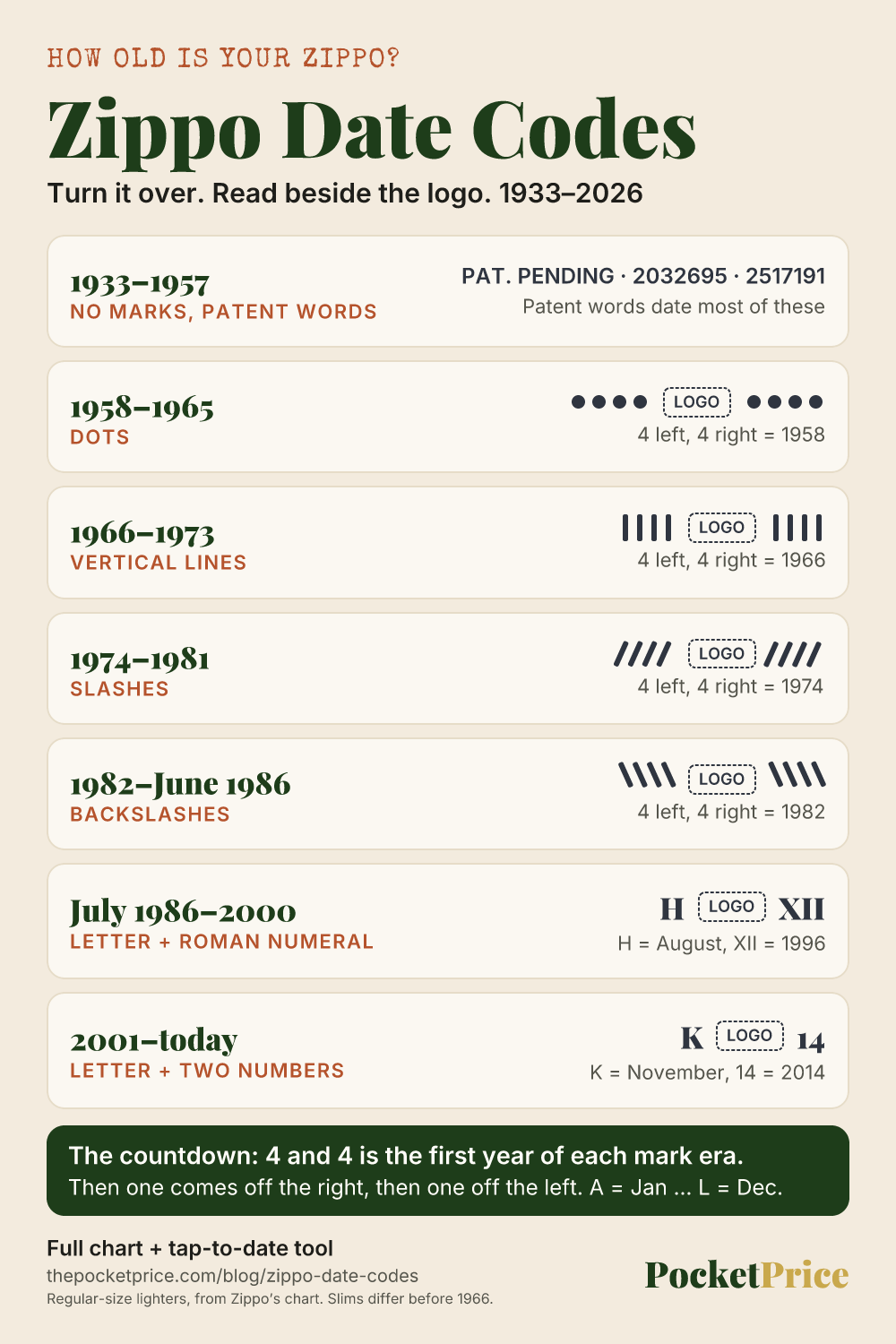
- Dots, lines, slashes or backslashes? The shape is the era: dots 1958 to 1965, vertical lines 1966 to 1973, slashes 1974 to 1981, backslashes 1982 to mid-1986. The count is the year: four on each side is the first year, then one comes off the right, then one off the left.
- No marks at all? Read the words. PAT. PENDING, PAT. 2032695 or PAT. 2517191 date it to 1933 through the 1950s.
- Is it a slim? The narrower slim lighters ran their own dot codes until 1966. Use the slim chart below for those.
Date My Zippo: Tap What You See
Pick the kind of mark on your lighter's bottom, tap the count or the letter, and the year shows up. It's free and works right here on the page.
Date my Zippo · free, no sign-up
What do you see on the bottom, beside the logo?
Answers come from Zippo's own date code chart. January = A, December = L.
Zippo Date Code Chart (1933–2026)
From 1958 to mid-1986 every era counts down the same way, so one grid covers 28 years. Find your count in the left column and your kind of mark across the top.
Here is the full chart, year by year, for regular-size lighters. The marks are what you'll see to the left and right of the logo.
| Year | Left of logo | Right of logo | Note |
|---|---|---|---|
| 1933 | No date marks. Bottom reads PAT. PENDING | First lighters. | |
| 1937–about 1950 | No date marks. Bottom reads PAT. 2032695 | ||
| 1942–1946 | No date marks. Bottom reads PAT. 203695 | Black crackle. Misprint of 2032695. | |
| about 1950–about 1957 | No date marks. Bottom reads PAT. 2517191 | ||
| about 1950–about 1957 | No date marks. Bottom reads PAT. 2517191 and PAT. PEND. | ||
| 1958 | 4 dots | 4 dots | Zippo’s chart also shows Patent Pending wording. |
| 1959 | 4 dots | 3 dots | Some references list three left, four right. |
| 1960 | 3 dots | 3 dots | Dots |
| 1961 | 3 dots | 2 dots | Dots |
| 1962 | 2 dots | 2 dots | Dots |
| 1963 | 2 dots | 1 dot | Dots |
| 1964 | 1 dot | 1 dot | Dots |
| 1965 | 1 dot | none | Dots |
| 1966 | 4 vertical lines | 4 vertical lines | Vertical lines |
| 1967 | 4 vertical lines | 3 vertical lines | Vertical lines |
| 1968 | 3 vertical lines | 3 vertical lines | Vertical lines |
| 1969 | 3 vertical lines | 2 vertical lines | Vertical lines |
| 1970 | 2 vertical lines | 2 vertical lines | Vertical lines |
| 1971 | 2 vertical lines | 1 vertical line | Vertical lines |
| 1972 | 1 vertical line | 1 vertical line | Vertical lines |
| 1973 | 1 vertical line | none | Vertical lines |
| 1974 | 4 slashes | 4 slashes | Slashes |
| 1975 | 4 slashes | 3 slashes | Slashes |
| 1976 | 3 slashes | 3 slashes | Slashes |
| 1977 | 3 slashes | 2 slashes | Slashes |
| 1978 | 2 slashes | 2 slashes | Slashes |
| 1979 | 1 slash | 2 slashes | Two versions, both on Zippo’s chart. |
| 1979 | 2 slashes | 1 slash | Second 1979 version. |
| 1980 | 1 slash | 1 slash | Slashes |
| 1981 | 1 slash | none | Slashes |
| 1982 | 4 backslashes | 4 backslashes | Backslashes |
| 1983 | 4 backslashes | 3 backslashes | Backslashes |
| 1984 | 3 backslashes | 3 backslashes | Backslashes |
| 1985 | 3 backslashes | 2 backslashes | Backslashes |
| 1986 (Jan–Jun) | 2 backslashes | 2 backslashes | Backslashes until June; letter codes from July. |
| 1986 (Jul–Dec) | G–L (month) | II | G = July. Letter codes start. |
| 1987 | A–L (month) | III | |
| 1988 | A–L (month) | IV | |
| 1989 | A–L (month) | V | |
| 1990 | A–L (month) | VI | |
| 1991 | A–L (month) | VII | |
| 1992 | A–L (month) | VIII | |
| 1993 | A–L (month) | IX | |
| 1994 | A–L (month) | X | |
| 1995 | A–L (month) | XI | |
| 1996 | A–L (month) | XII | |
| 1997 | A–L (month) | XIII | |
| 1998 | A–L (month) | XIV | |
| 1999 | A–L (month) | XV | |
| 2000 | A–L (month) | XVI | Last Roman numeral year. |
| 2001–2009 | A–L (month) | 01–09 | H 04 = August 2004 |
| 2010–2019 | A–L (month) | 10–19 | K 14 = November 2014 |
| 2020–2026 | A–L (month) | 20–26 | B 26 = February 2026 |
Source: Zippo’s official date code chart (regular and slim lighters), checked against collector references. Where they disagree, the note says so.
Slim Zippo date codes (1956–1965)
Zippo's slim lighter came out in 1956 with a flat bottom and no code. From 1957 slims carried their own dots, running about a year ahead of the regular lighters: Zippo's chart lists four and four for both 1957 and 1958, then three and three for 1959 (a regular lighter with three and three is 1960). A 1965 slim has no code at all, and from 1966 on slims use the same codes as regular lighters.
| Year | Left of logo | Right of logo | Note |
|---|---|---|---|
| 1956 | Flat bottom, no date code | First slims. | |
| 1957 | 4 dots | 4 dots | |
| 1958 | 4 dots | 4 dots | Two versions. |
| 1958 | 4 dots | 3 dots | Second 1958 version. |
| 1959 | 3 dots | 3 dots | |
| 1960 | 3 dots | 2 dots | |
| 1961 | 2 dots | 2 dots | |
| 1962 | 2 dots | 1 dot | |
| 1963 | 1 dot | 1 dot | |
| 1964 | 1 dot | none | |
| 1965 | No date code | From 1966, regular codes. | |
Zippo Date Codes, Era by Era
1933 to the mid-1930s: PAT. PENDING
Years: Zippo's first lighters, from 1933. What it looks like: no date marks, the name in plain block capital letters, and PAT. PENDING. Many of the earliest lighters also have the hinge on the outside of the case. Example: a block-letter bottom reading PAT. PENDING with no marks. Zippo's first patent, number 2032695, was granted in March 1936, and Zippo's chart starts that number in 1937. Collector references see it on some 1936 lighters, so a Patent Pending bottom is most likely 1933 to 1936.
About 1937 to the early 1950s: PAT. 2032695
What it looks like: no date marks, block letters, and PAT. 2032695. Example: a 1940s chrome lighter with that patent number. Zippo's chart says 1937 to about 1950. Collector references see the number until about 1953, when the second patent number replaced it, so the two overlap.
World War II, 1942 to 1946: black crackle and PAT. 203695
Brass went to the war effort, so Zippo made steel cases with a rough black crackle paint. Zippo's chart lists these lighters with PAT. 203695, a number stamped in error: it should have read 2032695. A collector reference says the misprint shows on some early-war lighters and that most 1943–1945 black crackles carry the correct 2032695, so either number can be genuine. One thing to know before you pay wartime money: Zippo still sells a black crackle finish today, and a black crackle with a letter-and-number code on the bottom is a modern lighter.
About 1950 to 1957: PAT. 2517191
Zippo's second patent, 2517191, was issued on August 1, 1950. Zippo's chart lists it from about 1950 to about 1957, on its own and with PAT. PEND. beside it. Collector references put the first bottoms with it around 1953. Zippo moved from block letters to its slanted script logo on the bottom stamp around 1955.
The mid-1950s are the hardest years to pin down. Zippo says its codes began in the mid-1950s and that most lighters made from 1933 to 1957 are dated by style, model and patent wording, not a code. Collector references report dot codes on some 1955–1957 lighters, including four and four, and they don't agree on every pattern. If a dotted lighter matters to the price, a collector's book with photos of mid-1950s bottoms is the next step.
1958 to 1965: dots
What it looks like: dots to the left and right of the script logo. 1958 has four on each side; each year one dot comes off, first on the right, then on the left, down to a single dot on the left in 1965. Example: three dots left and two right is 1961. Zippo's chart shows 1959 as four dots left and three right; at least one collector reference lists it the other way around. Either way, seven dots in all on a regular-size lighter points to 1959.
1966 to 1973: vertical lines
What it looks like: short straight lines in the same countdown, four and four in 1966 down to one line on the left in 1973. Example: two lines left and one right is 1971. From 1966 on, slim lighters use the same codes as regular ones.
1974 to 1981: slashes
What it looks like: forward slashes, four and four in 1974 down to one on the left in 1981. The redesigned logo, with a flame over the i, came onto the bottom stamp in 1980. Example: three slashes left and two right is 1977. 1979 comes two ways: Zippo's chart lists both one slash left and two right, and two left and one right. Collector references describe one of them as a stamping mix-up corrected during the year. Both are real 1979s.
1982 to June 1986: backslashes
What it looks like: backslashes, leaning the other way, from four and four in 1982 to two and two in the first half of 1986, when the system changed mid-year. Example: three backslashes left and two right is 1985.
July 1986 to 2000: a letter and a Roman numeral
What it looks like: a letter on the left is the month, A for January through L for December. A Roman numeral on the right is the year: II is 1986 (July through December only, so G through L), III is 1987, and so on to XVI for 2000. The quick math is to add 1984 to the numeral. Example: H XII is August 1996.
2001 to today: a letter and two numbers
What it looks like: the same month letter, with the year as two numbers. Zippo's own example is 14 for 2014. Example: K 14 is November 2014, and B 26 is February 2026.
The logo is a second clue
- 1933 to the mid-1950s: the name in plain block capital letters.
- About 1955 to 1979: the slanted script logo, which Zippo phased onto the bottom stamp around 1955.
- 1980 on: the redesigned logo, with a flame over the i.
A code and a logo from different eras on the same bottom is a warning sign, covered in the red flags below.
Made in Canada?
Zippo's chart covers lighters made in Bradford, Pennsylvania. Zippo also ran a plant in Niagara Falls, Ontario, from 1949 to 2002. Collector references say those lighters were coded differently, so date one stamped Niagara Falls with a reference for Canadian Zippos.
What a Zippo Is Worth by Era
The date code sets the starting point. These are typical booth and estate sale prices for a plain lighter in good, working condition.
| On the bottom | Years | Typical price |
|---|---|---|
| Letter and two numbers | 2001 to today | $10–$25 |
| Letter and Roman numeral | July 1986 to 2000 | $10–$25 |
| Slashes or backslashes | 1974 to mid-1986 | $15–$35 |
| Vertical lines | 1966 to 1973 | $20–$45 |
| Dots | 1958 to 1965 | $25–$60 |
| PAT. 2517191 | 1950s | $25–$60 |
| PAT. 2032695, chrome or brass | Late 1930s to early 1950s | $50–$150 |
| Black crackle, PAT. 203695 or 2032695 | 1942 to 1946 | $200–$600+ |
| PAT. PENDING | 1933 to mid-1930s | Several hundred and up |
Typical ranges as of November 2026. Prices vary by area and condition. Check yours free to see what it'll bring near you.
The date code isn't the price. Two lighters from the same year can sell $15 apart or $150 apart. What moves the number:
- Graphics: an oil company, tractor, railroad or beer logo, or a military unit, ship or squadron, can multiply a plain lighter's price. Advertising Zippos from the 1950s to the 1970s bring $40–$150.
- Finish: black crackle, sterling silver and hand-painted Town & Country cases sell well above chrome.
- Condition: a tight hinge, a clean snap and crisp graphics; dents, heavy wear and a loose lid cut it.
- The insert: an insert from the same era as the case adds a little on collector pieces; a modern insert in an old case takes some off.
Finish, graphics and the other lighter brands are priced out in the vintage Zippo value guide, and the collectibles price guide covers the rest of the display case.
Fakes and Red Flags
Zippo registered the shape of its lighter as a trademark in 2002 to fight counterfeits, and fakes still turn up at flea markets and online. The date code is the fastest check, because copies often get it wrong:
- A code that isn't on the chart: five marks on a side, no marks on the left, a letter past L, or more marks on the right than the left (Zippo's chart has that only for one version of 1979).
- A code that doesn't fit the stamp: a block-letter name with a letter-and-number code, or the flame logo with dots or lines.
- A war story that doesn't fit the date: a lighter engraved “Vietnam 1968” can't have a 1990s code. Many engraved Vietnam lighters are new engraving on old or modern cases.
- Black crackle sold as wartime with a letter-and-number code on the bottom. Zippo still makes that finish.
- Soft, shallow or crooked stamping, misspelled words, or a logo that looks off. Real stamps are deep and even unless years in a pocket wore them down.
- A light, thin case, a lid that wobbles, or a dull click instead of a clean snap when it closes.
- An insert with no maker's name, or one that rattles in the case. Genuine inserts are stamped with the Zippo name.
Zippo's own replicas are a different thing. The 1932 Replica and 1941 Replica are genuine Zippos made in recent decades, and the year in the name is the design, not the date. The code on the bottom tells you when it was made.
Can't make out the marks?
A worn bottom can lose a dot or a slash, and that changes the year. Count under magnification before you write a date on the tag; our guide to using a jeweler's loupe shows how to hold one.
Dating a Whole Box of Lighters
- Sort by mark first: patent words, dots, lines, slashes, backslashes, letter codes. That puts the box in decades in a few minutes.
- Pull the slims and date them off the slim chart; before 1966 they don't match the regular codes.
- Write the year on a small tag with any graphics (“1967, Texaco”). Dated lighters sell better than unlabeled ones, the same as dated vintage pocket knives.
- Set aside anything whose code doesn't fit and check it against the red flags.
- Group the common ones: plain lighters from 1986 on can go at one price, like $12 each or 3 for $30.
Shopping for one? See dated 1950s and 1960s Zippo lighters on eBay → (opens in a new tab)
Before You Tag It: Make Sure It Lights
A lighter that sparks and lights sells to gift buyers; one that doesn't sells to collectors only. A fresh flint and wick (opens in a new tab)fresh flint and wick takes a minute to put in and makes a common Zippo an easy stocking stuffer. Let the fuel dry out completely before you ship one.
Save the Cheat Sheet
Keep the chart on your phone for estate sales and flea markets. The cheat sheet has every era on one page; save it or pin it.
Related Guides
For prices by finish and graphics, see the Zippo lighter value guide. Military unit lighters sell to the same buyers as the rest of the militaria price guide.
Quick answers
How do I read the date code on a Zippo?
Turn the lighter over and look on both sides of the logo. A letter on the left, A through L, is the month, and the right side is the year: a Roman numeral from July 1986 to 2000 (XII is 1996) or two numbers from 2001 on (14 is 2014). Dots, lines, slashes or backslashes mean 1958 to mid-1986, and no marks with patent wording means 1933 to the 1950s.
What do the dots on a Zippo mean?
Dots date regular-size Zippos from 1958 to 1965. Four dots on each side is 1958, then one dot comes off the right, then one off the left, each year: three and three is 1960, two and two is 1962, and a single dot on the left is 1965. Slim lighters ran their own dot codes about a year ahead until 1966, so a slim with three and three is 1959, not 1960.
What do Roman numerals on a Zippo mean?
They are the year, used from July 1986 through 2000. II is 1986, III is 1987 and so on to XVI for 2000, so add 1984 to the numeral. The letter on the other side is the month, A for January through L for December, so H XII is August 1996.
What if my Zippo has no date code?
A regular lighter with no marks and patent wording (PAT. PENDING, PAT. 2032695 or PAT. 2517191) dates from 1933 to the 1950s. Slim lighters from 1956 and 1965 have no code either. A lighter from 1958 on that should have a code but does not may be worn, polished or not genuine.
Does the date code tell me what my Zippo is worth?
It tells you the era, which sets the starting point, not the price. Most Zippos from 1986 on sell for $10 to $25 and plain 1958 to 1965 lighters for $25 to $60, while advertising or military graphics, black crackle, sterling and condition can multiply that. Snap a photo with PocketPrice to see what yours brings near you.
Related price guides
Keep reading
 How to Price Antiques: The Complete Guide for Resellers, Booth Vendors, and Estate Sale ProsThe five things that set an antique's value, how to find real sold prices, pricing rules by category, and the…
 Household Items Worth More Than You Think (That You Probably Already Own)Cast iron in the cabinet, Pyrex in the cupboard, a signed painting nobody noticed — most people walk past…
 Looking for a WorthPoint Alternative? Why Sellers Switch to PocketPriceLooking for a WorthPoint alternative? PocketPrice prices antiques and vintage from a photo, calibrated to…
 Grandmacore Is Back: Vintage Figurines, Trinket Dishes & Jewelry Boxes Worth Money (2026)Most vintage figurines sell for $8–$40. Lladró, Dresden lace and head vases bring $30–$250, trinket boxes…